

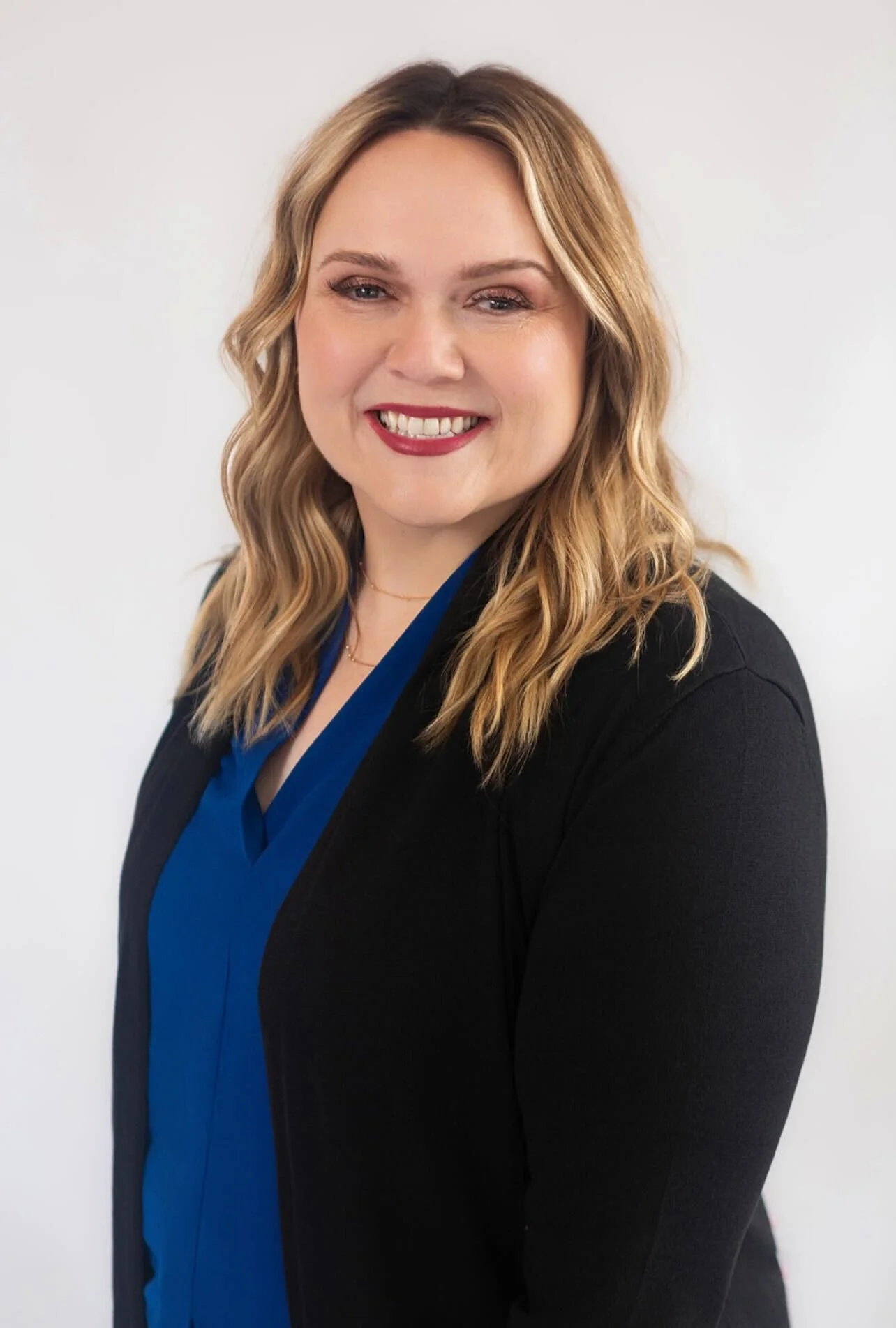
Stephanie Bono, JD, PhD, LP
Serving clients in Missouri and Illinois
Specializing in:
Psychosexual evaluations
Parental capacity/fitness evaluations
Violence-risk assessments
Pretrial therapeutic treatment
Court mandated therapeutic treatment
Compulsive pornography use
Emotional and behavioral regulation
Complex trauma
Relationship and family concerns
Adult Autism and ADHD
Professional Consultation and Training
Professional Experience:
I am a licensed psychologist practicing in Missouri and Illinois, with a Juris Doctor degree and advanced training in forensic psychology, psychological assessment, and behavioral health treatment.
My legal training gives me a strong understanding of the systems in which forensic evaluations and mandated treatment occur. I understand how referral questions are developed, how court and probation processes operate, and how evaluations, treatment recommendations, and clinical opinions are used by attorneys, courts, probation and parole officers, and agencies. At the same time, my work remains grounded in psychology, clinical judgment, and the individual person behind the legal matter.
My training and clinical work have intentionally spanned diverse clinical, forensic, and behavioral health settings. This allows me to work with concerns that often overlap, including trauma, emotional and behavioral dysregulation, substance use, neurodivergence, family conflict, compulsive sexual behavior, relationship difficulties, and concerns affecting treatment engagement, risk, and long-term stability.
I developed Restorative Pathways’ therapeutic treatment framework to provide something more clinically meaningful than compliance-focused treatment. The Archway Program is designed to be consistent with ATSA standards and integrates risk-need-responsivity principles, the Good Lives Model, desistance-focused work, trauma-informed care, mental health treatment, and practical skills development.
Treatment addresses accountability and risk-related concerns while also attending to the factors that influence whether change is possible. Depending on the individual, this may include emotional regulation, mental health, trauma, healthy sexuality, relationships, substance use, decision-making, problem-solving, and access to appropriate community resources.
I also understand the needs of the professionals involved in these cases. Attorneys, courts, probation and parole officers, and agencies need providers who communicate clearly, understand role boundaries, document appropriately, and maintain independent clinical judgment. My goal is to provide work that is clinically sound, legally informed, and useful to the people responsible for making important decisions.
What I would like you to know:
Sometimes, the hardest part is not deciding to get help, but finding a place to go.
Concerns involving compulsive or problematic sexual behavior, pending legal matters, mandated treatment, or a family member facing an allegation call for a particular kind of training and a particular kind of steadiness, and there are only so many places where both are available. I opened Restorative Pathways so that the search itself would not become one more reason a person gives up. When someone is willing to work on something this difficult, that willingness is worth meeting.
This is not gentle work.
It requires holding several things at once and refusing to let any of them cancel the others out. The behavior is serious and I treat it that way. So is the history that runs underneath it, the mental illness that may be shaping it, the losses that went unaddressed for years, and the plain absence of resources that made a different choice harder to reach. None of that excuses anything, and I do not offer it as though it did, but leaving it out produces treatment that addresses a category rather than a person. Everyone who sits down with me arrives with a particular set of circumstances that will not be found in anyone else, and the work only moves when I understand that set rather than the one I expected.
Public safety is not built by restriction alone.
We have decades of research telling us what actually reduces risk, and very little of it is about what a person is prohibited from doing. Steady employment, stable housing, relationships that hold, meaningful connection to other people, and a future worth protecting are the conditions under which change endures. These are the factors that move, and they move in both directions. Yet the effort around a justice-involved person still concentrates almost entirely on containment, because containment is easier to define, easier to document, and easier to defend. I understand why the field developed that way. I also know that a person given nothing but a list of prohibitions has been given nothing to move toward, and that the community absorbing the result of that has a stake in it that no condition of supervision addresses. What works and what has been customary are not always the same thing, and where they diverge, I follow the evidence.
Every one of these cases belongs to a community, not only to the person in front of me.
The outcome reaches an employer deciding whether to keep someone on, a school working out what it has been told, neighbors forming a view, a spouse or parent absorbing consequences they had no part in creating, and a wider public with a real and reasonable interest in whether this happens again. Those people are rarely given anything useful, and they are the ones closest to the outcome. Families in particular tend to be the most durable resource a person has and the least supported people in the process. I work with them directly, and I answer the questions the systems around a case are not built to answer, because a person surrounded by people who understand what is happening is more likely to hold the change, and because when that support is absent the cost does not disappear. It moves outward. Safer communities are made by the same things that reduce individual risk, which is why I am not willing to treat this as work that ends at the door of my office.